AI is rewriting work faster than workforce planning
September 7, 2026 - 2:16 PM

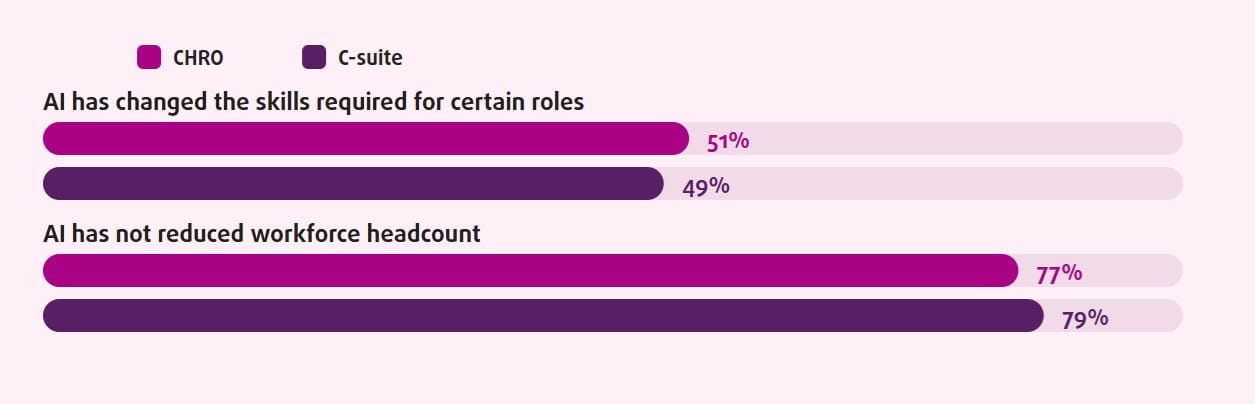
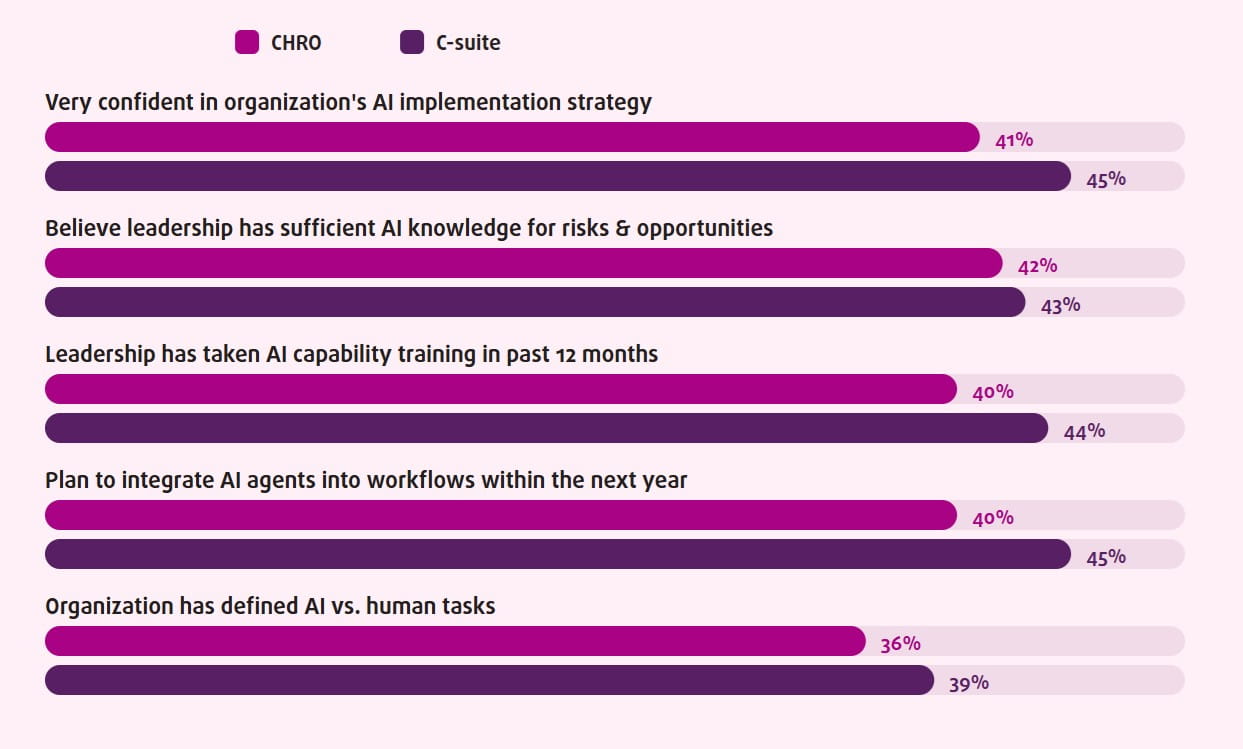
The 2026 CHRO data from The Adecco Group suggests many organisations are operating on a different timeline than the one they've communicated to employees. AI is already reshaping jobs, skills, and workflows, yet leadership confidence in managing that transition remains far less certain. More than half of CHROs (51%) say AI has already changed the skills required for roles within their organisation, but only 41% feel very confident in their AI implementation strategy. That gap between transformation already underway and leaders' readiness to guide it is one of the defining tensions facing organisations today.
Put simply, AI is moving faster than workforce planning. While jobs are evolving in real time, many organisations are still working to establish the governance, accountability, and talent strategies needed to support that change at scale. The result is a widening gap between what the workforce needs next and how prepared leaders feel to deliver it.
Key takeaways
- AI Agents are the #1 megatrend for C-suite, today and five years from now ahead of digitisation, automation, and geopolitical uncertainty.
- 51% of CHROs say AI has already changed the skills required for certain roles, and 49% of C-suite agree, but 37% have adjusted their job descriptions as a result
- 44% of CHROs say AI has broadened job opportunities for workers, and 41% of C-suite agree)
- Nearly 8 in 10 CHROs (77%) say AI has not reduced workforce headcount, but 39% expect this to change within the next 12 months.
- Only 41% are very confident in their AI implementation strategy, and just 38% say leaders are held accountable for how AI decisions affect people.
- Only 36% of organisations have clearly defined which tasks should go to humans versus AI
AI has already changed work. It hasn't (yet) changed headcount.
Start with the finding most likely to surprise a boardroom: AI's impact on jobs so far looks more like redesign than replacement.
C-suite agrees the bigger workforce impact is job redesign
The Adecco Group, 2026 Business Leaders Research, Q10: Has AI impacted your organisation in the following ways?
But that stability looks somewhat uncertain. While nearly 8 in 10 CHROs say AI has not yet reduced workforce headcount, 39% expect workforce reductions within the next 12 months. At the same time, 31% are actively reducing management layers to create leaner, more agile organisations, suggesting organisations are preparing for workforce change even if they have not yet experienced its full effects.
As Joe Bast, SVP of People Operations at Crisp, notes, the challenge may be less about job loss and more about career progression. "So many of the entry-level jobs are being done by AI or automated and being run by senior people with agents that the junior person's not going to acquire the experience in the five or six or eight years they need to be the senior person because those entry-level jobs aren't there," said Bast.
His perspective highlights a central challenge facing organisations today: AI is already reshaping how work gets done, but the long-term workforce implications are still unfolding. The question is no longer whether jobs and skills will change, but how leaders will guide employees through that change while maintaining trust, performance, and organisational stability.
For many organisations, that means prioritising workforce redeployment as job redesign unfolds. As AI automates tasks and changes skill requirements, the challenge becomes helping employees move into adjacent roles, acquire new capabilities, and access internal career opportunities before talent gaps need to be filled externally.
That makes AI governance increasingly critical. Organisations must move beyond technology deployment and establish clear accountability, decision-making frameworks, and communication strategies that ensure employees understand not only how AI is being used, but what it means for the future of their work.
Leaders are moving fast. Governance is not keeping up.
If jobs are being redesigned faster than they're being eliminated, the obvious next question is whether organisations are managing that redesign responsibly. The data suggests they're struggling to keep pace.
Business Leaders See AI Governance as a Work in Progress
The Adecco Group, 2026 Business Leaders Research, Q11: To what extent do you agree/disagree with the following statements about your company's use of AI?
The push to deploy AI is moving quickly, but the supporting infrastructure that makes transformation sustainable, including training, accountability, clear human-AI task boundaries, and workforce planning, is developing much more slowly. In many organisations, the technology rollout is outpacing the systems needed to guide employees through the change.
Executive Insight
“The real importance on future proofing is ensuring that you are doing a couple of things and you don't have the luxury of doing them separately. You have to do them all at once,” said Quentin SaLay, Chief Global People Officer at Freewheel.
SaLay points to Dartmouth professor Vijay Govindarajan's "Three Box Solution" as a framework for managing this challenge. Box One focuses on maintaining the present: keeping the business running, achieving strategic goals, and staying competitive in today's market. Box Three is about creating the future, identifying emerging competitors, anticipating market shifts, and building the skills employees will need in a fundamentally different operating environment.
The tension lies in doing both simultaneously. "How do you, while you are in Box One, simultaneously future-proof, build up those skills so that when you step into the future, which arguably is now, your employees have that elevated skillset?" SaLay asked.
That challenge becomes even more difficult when organisations must also confront Box Two: abandoning the past. Legacy processes, systems, and even long-held assumptions about how work gets done may no longer serve an AI-enabled future. Yet many companies are accelerating AI adoption before they've fully addressed what must change, what must be preserved, and how employees will be prepared for new ways of working.
The result is a growing governance gap. AI is reshaping work faster than many organisations can redesign policies, career paths, internal mobility frameworks, and talent strategies around it. The organisations most likely to benefit from AI will not simply automate tasks. They will create clear pathways for employees to transition into emerging roles through redeployment, reskilling, and skills-based career mobility.
The skills that are actually growing
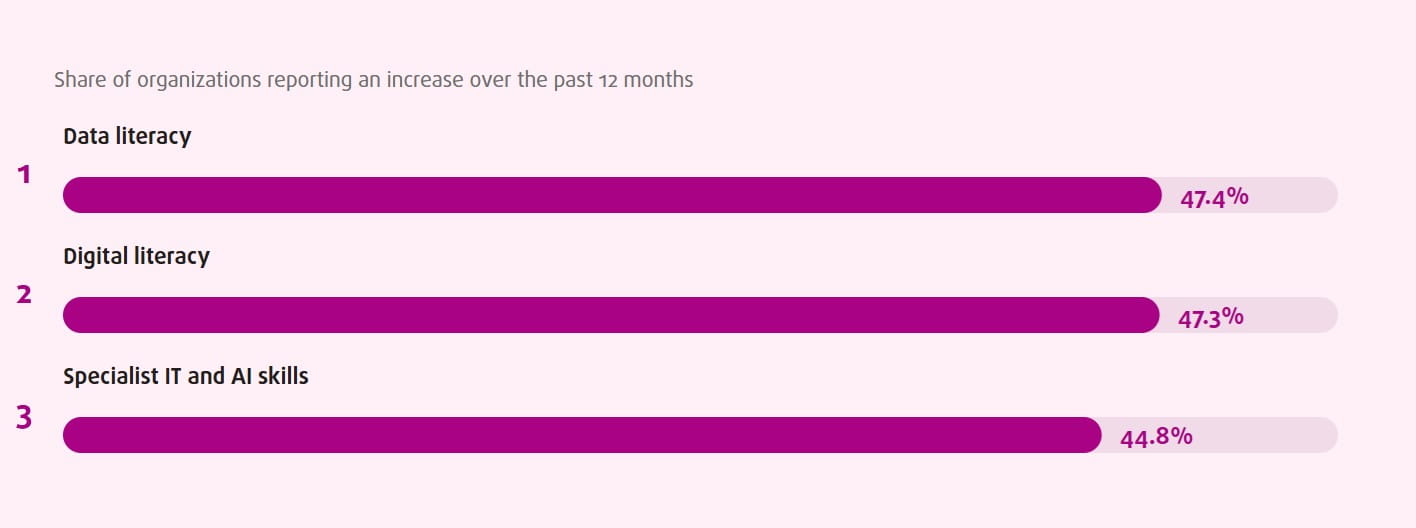
Over the past 12 months, digital, data, and AI-related capabilities recorded some of the largest gains across the workforce.
The Adecco Group, 2026 Business Leaders Research, Q19: How have workforce capabilities in the following areas changed over the last 12 months?
These investments are logical. As AI becomes embedded in everyday workflows, organisations need employees who can interpret data, navigate digital environments, and effectively use AI-powered tools.
But the findings also reveal an important imbalance. While technical capability is growing, workforce development is not always keeping pace with the broader demands of an AI-driven workplace. Only 24% of organisations report balancing technical and human-skills development.
That matters because technical proficiency alone is not enough. Skills such as critical thinking, judgment, adaptability, communication, and leadership are what enable employees to apply AI effectively, responsibly, and creatively. They are also the capabilities that become increasingly valuable as routine work is automated.
The emerging challenge is no longer just skill acquisition. It is career development. As AI reshapes how work gets done, organisations must ensure employees can still accumulate the experience, judgment, and institutional knowledge that have traditionally been built through early-career roles and on-the-job learning.
Taken together, the data suggests organisations are making progress in developing the skills needed to work with AI. What remains less clear is whether they are creating the pathways employees need to build careers in an AI-enabled workplace. The technology transformation is accelerating. Workforce planning is still trying to catch up.
What this means for CHROs
The real risk sits in the governance gap. Closing that gap doesn't require slowing down. It requires treating governance, accountability, human-AI task design, and workforce redeployment as part of the deployment strategy itself. The organisations that navigate AI most successfully will be those that create visible pathways for employees to move into new work and evolving skills adjacencies.
The workforce challenge is increasingly one of redeployment, not replacement. As AI reshapes tasks and skill requirements, organisations will need stronger internal mobility and reskilling strategies to move talent into emerging roles.
Frequently asked questions
Is AI actually reducing jobs, according to CHROs? Not yet. 77% of CHROs say AI has not reduced their workforce headcount, and 44% say AI has broadened job opportunities. However, 39% expect headcount impact within the next 12 months.
How confident are CHROs in their AI implementation strategy? Only 41% are very confident. Just 42% believe their leadership team has sufficient AI knowledge to understand the risks and opportunities involved.
Do most organisations have a policy governing AI use? No, nearly one-third (32%) report having no formal policy governing AI use at all, and only 36% have clearly defined which tasks should be done by humans versus AI.
Have questions about your workforce strategy?
Every organisation is navigating workforce planning and talent strategy differently. Contact us to discuss how these findings compare with your own workforce challenges.
Contact LHH to start the conversation
Next in this series
Execution challenge #3: If you can't see your workforce, you'll keep hiring for it, on the skills-visibility gap compelling organisations to hire externally for capabilities that may already exist internally.