Career Reinvention Is a Defining Feature of Modern Employment and Organizations Must Know Their Role in It
New analysis of 418,000 displaced workers reveals that career reinvention is no longer an exception. It's a defining feature of modern employment. The bigger question is whether organizations are equipped to manage the consequences. In an era where layoffs increasingly happen in public view, the way organizations support departing employees has become a reputational issue as much as a talent issue.
August 31, 2026 John Morgan, President, Career Transition & Mobility, LHH

For decades, workforce planning operated on a predictable assumption: employees would largely progress within a defined function or career path. A marketer became a senior marketer. A customer service representative became a team leader. A project coordinator became a program manager.
The latest labor market data suggests that model is rapidly breaking down.
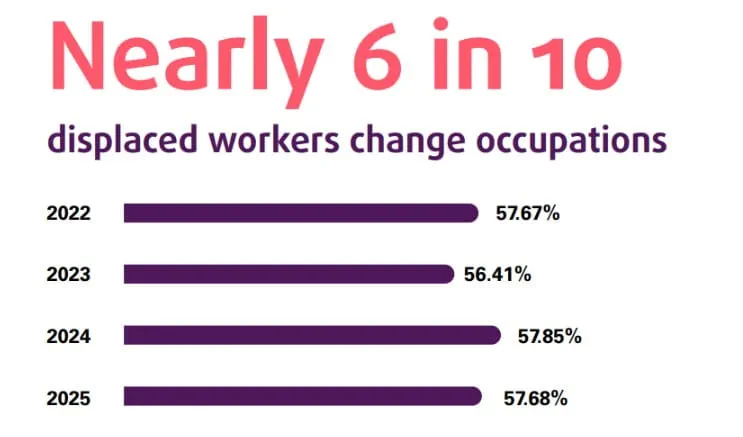
Analysis of more than 418,000 workers supported through LHH Career Transition services found that nearly 6 in 10 displaced workers move into an entirely different occupation following a layoff. Even more striking, that figure has remained remarkably stable, fluctuating between 56% and 58% for four consecutive years despite inflation, economic uncertainty, AI disruption, hiring freezes, and shifting labor market conditions.
Career reinvention is no longer a cyclical labor-market response. It is increasingly becoming a structural feature of employment.
Source: LHH 2026 Career Pivot Report
That shift is occurring alongside another significant trend: layoffs are no longer rare events. LHH's research shows that 87% of HR leaders report recent layoffs or anticipate them in 2026, while more than three-quarters describe layoffs as a recurring workforce-planning activity rather than a one-time event.
Together, these findings point to a new reality. Organizations are no longer managing isolated workforce disruptions. They are operating in an environment of continuous workforce reconfiguration.
The workforce-planning data many organizations are missing
The challenge is that most organizations still lack visibility into where displaced talent can realistically go next.
Take customer operations. The data shows that only 9.85% of displaced workers return to the same function after transition. The other, roughly 90% move into sales, operations, supply chain, project management, marketing, consulting, and other adjacent roles.
Historically, workforce transitions have been treated as an endpoint. Once a role disappears, the organization's involvement largely ends. But if the large majority of displaced workers are successfully transitioning into entirely different occupations, employers have an opportunity to play a much larger role in that process.
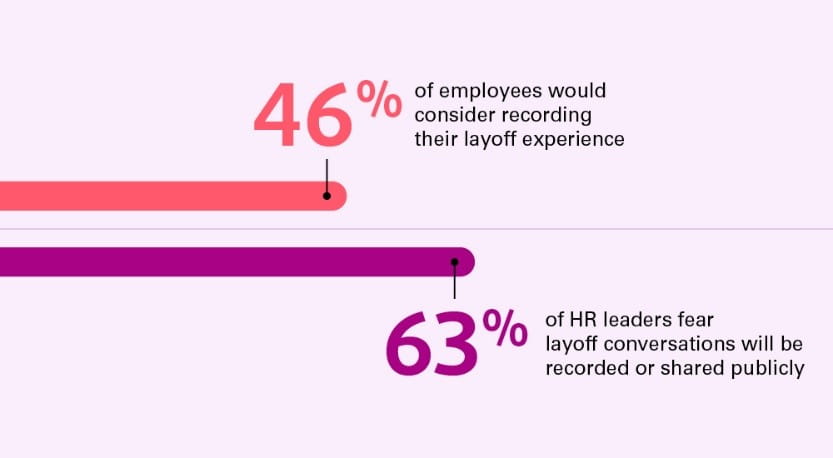
As layoffs increasingly happen in public view, the way organizations support departing employees has become a reputational issue as much as a talent issue. Companies that can identify adjacent opportunities, communicate realistic career pathways, and provide transition support are not only protecting workers. They are protecting employer brand, preserving trust among remaining employees, and reducing the long-term costs associated with repeated hiring and workforce churn.
Source: LHH 2026 Career Pivot Report
The emerging workforce divide may no longer be between organizations that restructure and those that don't. It may be between organizations that understand career movement and those that don't.
Read the full report to see real data around AI, job displacement, and career reinvention.