Transformation moves at the speed of trust
6 minutes
July 28, 2026

Trust isn't one item on the CHRO agenda. It's the hidden variable behind every other priority.
Across this series, we've examined why organizations struggle to execute on workforce transformation despite clear strategic intent. We've seen AI move faster than workforce planning. We've seen reskilling efforts stall despite widespread investment. We've seen organizations continue hiring externally because they lack visibility into internal talent.
At first glance, these appear to be separate challenges. Each execution gap traces back to the same underlying constraint: trust.
Employees are being asked to adapt to AI, learn new skills, rethink career paths, pursue internal opportunities, and navigate constant change. None of that happens at scale unless they trust leadership's intentions, believe development opportunities are real, and feel confident that organizational change will create future opportunities. Trust determines whether employees engage with mobility programs, pursue reskilling opportunities, and stay committed during periods of transformation.
That helps explain one of the most important findings in this year's CHRO research: employee trust, engagement, and transparency ranks as the #1 people-strategy priority for 2026. Organizations know trust matters, yet few have developed the capability to manage it. Trust ranks among leaders' top priorities, but the systems to measure, monitor, and improve it remain remarkably immature.
Key takeaways
- Trust is CHROs' #1 stated priority and workforce trust ranks as the second-lowest area of satisfaction from CHROs.
- 50% of organizations have only early-stage or ad hoc trust measurement; just 29% have a structured framework in place.
- Only 42% of CHROs say their leadership team shares a common vision, and only 41% believe leaders are prepared to use AI effectively in decision-making.
- Only 34% say employees trust the AI systems used in hiring and development, and just 37% have clearly communicated how AI will affect employees' jobs and careers.
- CHROs say trust is built through four specific, ranked behaviors, not abstract culture work.
Trust measurement is barely a discipline yet
Organizations increasingly recognize trust as a business priority, but few treat it like a business metric.
Nearly half of organizations (49%) either do not measure trust at all, have not moved beyond recognizing its importance, or rely primarily on informal methods such as pulse surveys. Another 30% measure trust in isolated areas like engagement or retention.
Only 21% have progressed to a cross-functional or fully embedded trust measurement framework.
Trust measurement maturity remains low
Key takeaways
- Trust is CHROs' #1 stated priority and workforce trust ranks as the second-lowest area of satisfaction from CHROs.
- 50% of organizations have only early-stage or ad hoc trust measurement; just 29% have a structured framework in place.
- Only 42% of CHROs say their leadership team shares a common vision, and only 41% believe leaders are prepared to use AI effectively in decision-making.
- Only 34% say employees trust the AI systems used in hiring and development, and just 37% have clearly communicated how AI will affect employees' jobs and careers.
- CHROs say trust is built through four specific, ranked behaviors, not abstract culture work.
Trust measurement is barely a discipline yet
Organizations increasingly recognize trust as a business priority, but few treat it like a business metric.
Nearly half of organizations (49%) either do not measure trust at all, have not moved beyond recognizing its importance, or rely primarily on informal methods such as pulse surveys. Another 30% measure trust in isolated areas like engagement or retention.
Only 21% have progressed to a cross-functional or fully embedded trust measurement framework.
Trust measurement maturity remains low
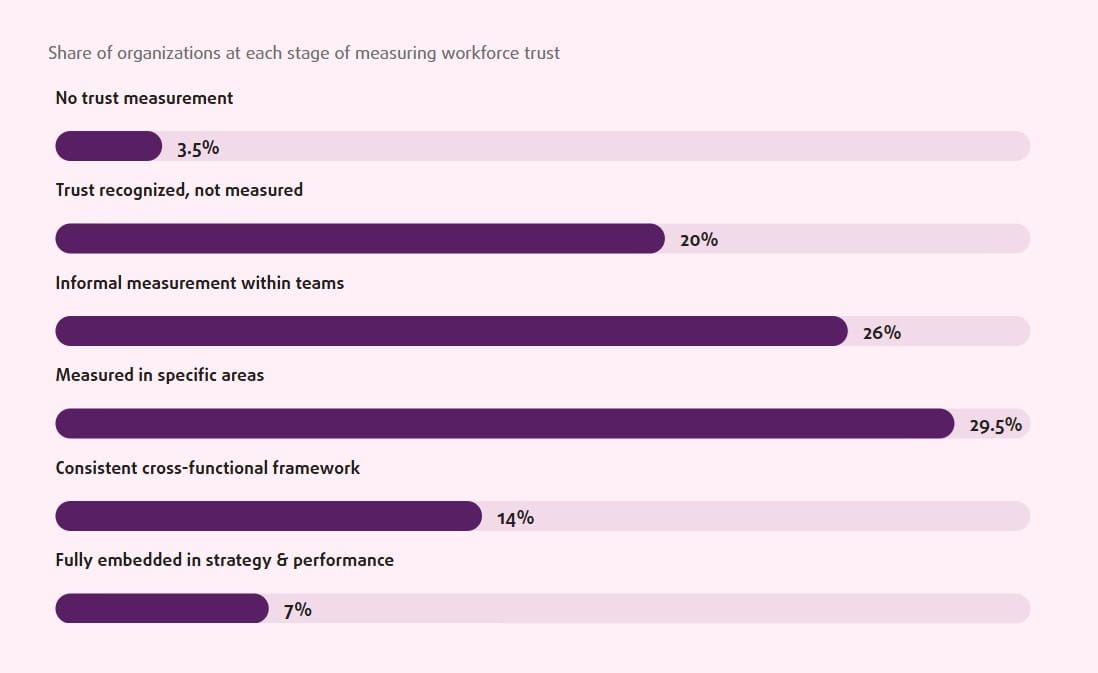
The Adecco Group, 2026 Business Leaders Research, Q5: Which statement best describes your organisation's current level of maturity in measuring workforce trust?
Most organizations are attempting to improve trust without a consistent way to understand whether it is increasing, decreasing, or affecting business outcomes.
Imagine treating revenue, productivity, or customer satisfaction this way. Yet many organizations approach trust as an aspiration rather than an operational metric.
That maturity gap helps explain why trust remains a top priority year after year.
Leadership credibility is under real pressure
The trust challenge starts with leadership
The trust gap is not primarily an employee problem. It's also a leadership challenge.
According to CHROs:
- Only 42% say leaders share a common vision.
- Only 43% say leaders are effective at guiding teams through change.
- Only 41% believe leaders are prepared to use AI effectively in decision-making.
- Only 37% say leadership teams align quickly around strategy.
The Adecco Group, 2026 Business Leaders Research, Q26: To what extent do you agree with the following statements about your leadership team?
These numbers reveal a striking pattern: many leaders are being asked to guide workforce transformation while still building confidence in their own ability to do so.
If employees are expected to embrace uncertainty, leadership must first demonstrate clarity.
Trust and AI adoption are directly connected
Employees don't fear AI. They fear uncertainty.
The strongest evidence that trust drives transformation appears in AI adoption.
Only:
- 34% say employees trust AI systems used in hiring and development.
- 37% have clearly communicated AI's impact on jobs and careers.
- 36% say their AI talent strategy shows employees how AI creates opportunities.
- Roughly 40% have yet to implement foundational trust-building practices around AI.
The problem is often framed as technology adoption, but the data suggests a communication and trust challenge instead.
As Lisa Skinner Källström, longtime CHRO and people leader observed, “A lot of people are afraid that if we get in too much to AI that you will be replaced."
Employees aren't rejecting AI itself. They're reacting to uncertainty about their future within an AI-enabled organization. That's a trust problem, not a technology problem.
Trust determines whether employees move
Organizations often frame workforce transformation as a skills challenge. In practice, it is frequently a trust challenge.
Employees are far more likely to embrace reskilling, internal mobility opportunities, mentoring relationships, leadership development programs, or redeployment initiatives when they believe those investments will lead to meaningful career growth.
Without trust, employees may view development programs skeptically, question whether internal opportunities are genuinely accessible, or assume transformation efforts are precursors to workforce reduction.
With trust, the same initiatives become signals that the organization is invested in helping people navigate change successfully.
Trust is built through four observable behaviors
Asked directly what builds workforce trust, CHROs converge on four specific, rankable behaviors:
- Helping employees understand their impact on the business (32%)
- Investing in upskilling (31%)
- Improving decision-making transparency (31%)
- Modeling ethical leadership and stability through change (30%)
What's striking is what doesn't appear on the list. There are no references to purpose statements, values campaigns, or culture programs. The highest-ranked trust drivers are behaviors that help employees understand what's happening, why it's happening, and what it means for them.
When those behaviors are sustained over time, trust becomes visible in how decisions get made and how people work together. Joe Bast, SVP People Operations at Crisp, describes the outcome:
"If they start meeting with you more than once a week, you do not have their trust. And your goal when working for that C-suite should be, I want to be fully trusted such that I can operate the way I want to operate and they know they're going to get the result they need. That full empowerment and full trust is a special thing when you can get it."
Bast's definition is notable because it frames trust not as employee sentiment, but as organizational capacity. High-trust environments require less oversight, fewer approval loops, and less time spent validating decisions. They move faster because trust reduces friction.
What this means for CHROs
The most important finding in this year's research may not be about AI, skills, or workforce planning. It's that trust appears to be the limiting factor behind all of them.
Employees don't experience transformation through strategies, operating models, or organizational charts. They experience it through career decisions: whether to learn a new skill, pursue an internal opportunity, work with a mentor, accept a new role, or navigate an unexpected transition.
Organizations that build trust make those decisions easier. They provide visibility into career pathways, invest in coaching and development, create opportunities for internal mobility, and support employees through periods of change.
The highest-performing organizations are treating trust not as a cultural outcome, but as the foundation of workforce transformation. Because people rarely move toward uncertainty unless they trust what comes next.
Frequently asked questions
What is the #1 CHRO priority for 2026? Improving employee trust, engagement, and organizational transparency, cited by 35% of CHROs, ahead of AI adoption and digital capability-building.
How do most organizations measure workforce trust? Informally. 50% have only early-stage or ad hoc trust measurement approaches, and just 29% have a structured, repeatable framework in place.
Do employees trust AI systems used in HR decisions? Not broadly, only 34% of CHROs say employees trust the AI systems used in hiring and development, and just 37% have clearly communicated how AI will affect employees' jobs and careers.
What do CHROs say actually builds trust? Four specific behaviors, in ranked order: helping employees understand their business impact (32%), investing in upskilling (31%), improving decision-making transparency (31%), and modeling ethical, stable leadership through change (30%).
Have questions about your workforce strategy?
Every organization is navigating workforce planning and talent strategy differently. Contact us to discuss how these findings compare with your own workforce challenges.
Contact LHH to start the conversation
About the research:
In the Minds of CHROs: 2026 Execution Gap is based in The Adecco Group, 2026 Business Leaders Research
2,000 C-suite executives (500 Chief Executive Officers, 500 Chief Human Resources Officers, 500 Chief Technology Officers, 250 Chief Operating Officers, 250 Chief Financial Officers)
13 countries (100 Canada, 300 US, 100 Belgium, 150 France, 150 Germany, 100 Italy, 100 Netherlands, 150 Spain, 100 Sweden, 100 Switzerland, 150 UK, 250 Australia, 250 Japan)
Industries (350 Aerospace and Defense; 350 Automotive and Transport, Logistics, Mobility and Manufacturing; 350 Healthcare, Life Sciences and Pharma; 350 Energy, Clean Technology and Utilities; 300 Technology; 300 FMCG, E-commerce, Retail and Consumer Goods and Supply Chain)